
Real Analysis: Derivatives
Mean Value Theorems
Overview
The mean value theorem is an important result of analysis that is not only immediately applicable to calculus problems but also instrumental in many proofs of more complex phenomena. In short, the mean value theorem states that if $f$ is continuous on an interval closed interval $[a, b],$ then there is some point $c$ in that interval at which the derivative $f'(c)$ is equal to the slope of the secant line running through $f(a)$ and $f(b).$
This section covers prerequisite concept of extrema and the attendant intermediate extremum theorem, and then introduces several variations of the mean value theorem.
Extrema
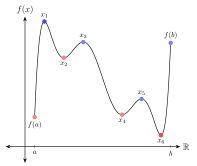
A real function $f$ has a global maximum at $x_0$ if $f(x) \leq f(x_0)$ for all $x$ in the domain of $f.$ Likewise, $f$ has a global minimum at $x_1$ if $f(x_1) \leq f(x)$ for all $x$ in the domain of $f.$ When the context is clear, the global qualifier is dropped, and these values are just referred to as the maximum and minimum values of the function. A function can have at most one global maximum and one global minimum, but can achieve either at many points in its domain.
A real function $f$ has a local maximum at $x_2$ if there exists some $\delta > 0$ such that $f(x) \leq f(x_2)$ for all $x$ in the domain of $f$ where $|x_2 - x| < \delta.$ Likewise, $f$ has a local minimum at $x_3$ if there exists some $\delta > 0$ such that $f(x_3) \leq f(x)$ for all $x$ the domain of $f$ where $|x_3 - x| < \delta.$ A function can have many local maxima or minima (the plural of maximum and minimum, respectively).
The global and local maximum and minimum values of a function are collectively referred to as is extrema (singular extremum), or extreme values.
Interior Extremum Theorem
It's easy enough to lay out the definitional test for the extrema of a function, but it's something else entirely to actually discover them. Most familiar real functions such as polynomials and rational functions (as well as transcendental functions like the exponential and trigonometric functions) are defined over all or nearly all of $\mathbb{R},$ making it impossible to determine the existence of extrema by exhaustion. For some very simple functions, such as the constant function or a monomial, we could make a bespoke argument using algebra and limits, but anything more complicated would be positively byzantine.
Derivatives to the rescue. A local extremum is a place where we should expect the derivative to be zero. If a continuous function transitions from increasing to decreasing, as it does a local maximum, this means its derivative must pass from being positive to being negative, and thus it must pass through $0.$ The interior extremum theorem formalizes just this fact.
The interior extremum theorem states that if a continuous real function $f$ is defined along an interval $(a, b),$ and has a local extremum at $c \in (a, b),$ then $c$ is a critical point of $f.$ Unpacking the definition of critical point lets us see that $f'$ is either undefined or zero at $c.$ The interior extremum theorem is also known as Fermat's theorem (which, due to the Frenchman's extensive accomplishments, makes it one of rather many such eponymous theorems).
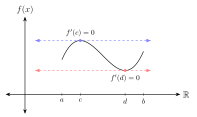
The usefulness of the interior extremum theorem comes from its establishment of a zero or undefined derivative as a necessary condition of an extremum. This drastically whittles down the search space for extrema from uncountably many real numbers to what is, for a large number of frequently encountered functions, a small, finite number of critical points.
However, the interior extremum theorem does not say whether a zero or undefined derivative indicates a local maximum or a local minimum. A visual inspection of the graph of a continuous function shows that a local maximum is one where the graph transitions from increasing to decreasing, and a local minimum is one with the opposite condition. These notions of increasing and decreasing are formalized in the concept of monotonicity. The mean value theorems are then used to connect derivatives and monotonicity, a process which culminates in the first derivative test.
Mean Value Theorems
The following three theorems connect the mean, or average, values of continuous differentiable functions defined along intervals to values that their derivatives take on. While the results of these theorems are visual and intuitive, their proofs rest on properties like continuity and compactness.
Rolle's Theorem
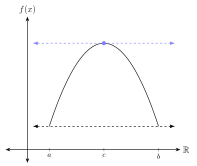
Rolle's theorem states that if a continuous real function $f$ is defined on a closed interval $[a, b]$ and differentiable on $(a, b)$ and $f(a) = f(b),$ then there exists some $c \in (a, b)$ such that $f'(c) = 0.$
The Mean Value Theorem
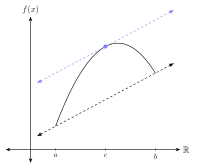
The mean value theorem states that if a continuous real function $f$ is defined in a closed interval $[a, b]$ and is is differentiable on $(a, b),$ then there exists some $c \in (a, b)$ such that
$$f'(c) = \dfrac{f(b) - f(a)}{b - a}.$$
In other words, there is some point at which the derivative equals the slope of the secant line between $(a, f(a))$ and $(b, f(b)).$
The Generalized Mean Value Theorem
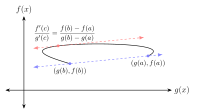
The generalized mean value theorem states that if $f$ and $g$ are both continuous real functions defined on the closed interval $[a, b]$ and differentiable on the open interval $(a, b)$, then there exists a point $c \in (a, b)$ such that
$$(f(b) - f(a))g'(c) = (g(b) - g(a))f'(c).$$
Note that the if $g(b) - g(a) \neq 0$ and $g'(c) \neq 0,$ we may rearrange the theorem as
$$\dfrac{f(b) - f(a)}{g(b) - g(a)} = \dfrac{f'(c)}{g'(c)}.$$
If $g(x) = x,$ then the generalized mean value theorem reduces to the standard mean value theorem.
Problems
Interior extremum theorem: Show that if $f$ has an local maximum at $c,$ then $c$ is a critical point of $f.$
If either $f$ or $f'$ is undefined at $c,$ then $c$ is a critical point. Otherwise, assume $f'(c)$ is defined. Recall that a limit exists if and only if both one-sided limits exist and are equal. Thus we note that
$$f'(c) = \lim\limits_{h \rightarrow 0^+}\dfrac{f(c + h) - f(c)}{h} = \lim\limits_{h \rightarrow 0^-}\dfrac{f(c + h) - f(c)}{h}.$$
Since $f$ has a local maximum at $c,$ there is an interval $(a, b)$ around $c$ such that $f(x) \leq f(c)$ for all $x \in (a, b) \cap \text{Dom}(f).$ If $0 < h < b - c,$ then $\dfrac{f(c + h) - f(c)}{h} \leq 0,$ and so $f'(c) = \lim\limits_{h \rightarrow 0^+}\dfrac{f(c + h) - f(c)}{h} \leq 0.$ Alternatively, if $c - a < h < 0,$ then $\dfrac{f(c + h) - f(c)}{h} \geq 0,$ and so $f'(c) = \lim\limits_{h \rightarrow o^-} \dfrac{f(c + h) - f(c)}{h} \geq 0.$ Since $0 \leq f'(c) \leq 0,$ it follows that $f'(c) = 0.$
Rolle's Theorem: Let $a, b \in \mathbb{R}$ where $a < b,$ and let $f$ be a continuous real function on $[a, b]$ that is differentiable on $(a, b)$ with the property that $f(a) = f(b).$ Then there exists some $c \in (a, b)$ such that $f'(c) = 0.$
Since $f$ is a continuous function of a compact set, $[a, b],$ it follows by the extreme value theorem that it attains its supremum and infimum in $[a, b].$ If $f(a)$ and $f(b)$ are both the global supremum and infimum, then $f$ is constant, and so $f'(x) = 0$ for all $c \in (a, b).$ In any other case, $f$ is not constant, and achieves at either its supremum or infimum (or both) inside $(a, b).$ Assuming one such point occurs at $c \in (a, b),$ it follows by the interior extremum theorem that $f'(c)=0.$
Mean value theorem: Show that if $f$ is differentiable along an interval $[a, b],$ then there is a point $c \in [a, b]$ such that $f'(c) = \dfrac{f(b) - f(a)}{b - a}.$
First, we construct the equation of a line through $(a, f(a))$ and $(b, f(b))$ and call it $g:$
$$g(x) = \dfrac{f(b)-f(a)}{b-a}(x - a) + f(a).$$
Note that $g$ is continuous and differentiable. Next, we construct $h$ as the difference between $f$ and $g:$
$$h(x) = f(x) - \left(\dfrac{f(b)-f(a)}{b-a}(x - a) + f(a)\right).$$
By construction, $h(a) = 0 = h(b).$ Likewise, since $f$ and $g$ are continuous and differentiable, it follows that their sum, $h,$ is also continuous and differentiable. Thus we may apply Rolle's theorem to deduce the existence of a point $c \in (a, b)$ such that $h'(c) = 0.$ Taking the derivative of $h$ gives us a handy equation:
$$h'(x) = f'(x) - \dfrac{f(b) - f(a)}{b-a}.$$
Thus when at we see
$$0 = f'(c) - \dfrac{f(b) - f(a)}{b-a},$$
which simplifies to the desired result:
$$f'(c) = \dfrac{f(b) - f(a)}{b-a}.$$
Generalized mean value theorem: Show that if $f$ and $g$ be continuous real functions defined over the closed interval $[a, b]$ and differentiable on the open interval $(a, b),$ then there exists a $c \in (a, b)$ such that
$$(g(b) - g(a))f'(c) = (f(b) - f(a))g'(c).$$
Let $h$ be the function defined by
$h(x) = (g(b) - g(a))f(x) - (f(b) - f(a))g(x).$
Because $f$ and $g$ are continuous on $[a, b]$ and differentiable on $(a, b),$ it follows that $h$ is also continuous on $[a, b]$ and differentiable on $(a, b).$ Differentiating with respect to $x$ gives
$h'(x) = (g(b) - g(a))f'(x) - (f(b) - f(a))g'(x).$
By the mean value theorem, there exists a point $c \in (a, b)$ such that $h'(c) = \dfrac{h(b) - h(a)}{b - a}.$ Crucially, note that $h'(c) = 0:$
$ h'(c) = \dfrac{h(b) - h(a)}{b - a} \\ h'(c) = \dfrac{((g(b) - g(a))f(b) - (f(b) - f(a))g(b)) - ((g(b) - g(a))f(a) - (f(b) - f(a))g(a))}{b - a} \\ h'(c) = \dfrac{((g(b) - g(a))(f(b) - f(a)) - (g(b) - g(a))(f(b) - f(a))}{b - a} \\ h'(c) = 0 $
Plugging this into the general equation for the derivative leads us to the desired result:
$ h'(c) = (g(b) - g(a))f'(c) - (f(b) - f(a))g'(c) \\ 0 = (g(b) - g(a))f'(c) - (f(b) - f(a))g'(c) \\ (g(b) - g(a))f'(c) = (f(b) - f(a))g'(c) $