
Real Analysis: Derivatives
Monotonicity and Concavity
Motivation: Analyzing the Shape of a Graph
One of the most valuable things to learn about a function is the shape of its graph. Many problems in mathematics, science, engineering, and computer science involve finding maximum or minimum values of a function. Likewise, many questions require knowing whether a function is increasing or decreasing along a given interval. Discovering these points and regions first involves formalizing our ideas of them. Since each concept concerns the rate at which the function is changing, we can use the derivative to help us discover them.
Monotonic and Constant Intervals
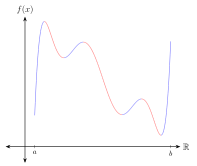
Consider a real function $f$ defined over an interval $[a, b],$ and consider all $x_1, x_2 \in [a, b]$ where $x_1 < x_2.$
-
$f$ is weakly monotonically increasing, or simply monotonically increasing, if $f(x_1) \leq f(x_2).$
-
$f$ is weakly monotonically decreasing, or simply monotonically decreasing, if $f(x_1) \geq f(x_2).$
-
$f$ is strictly monotonically increasing if $f(x_1) < f(x_2).$
-
$f$ is strictly monotonically decreasing if $f(x_1) > f(x_2).$
-
$f$ is constant if $f(x_1) = f(x_2).$
The terms "weakly" and "strictly" are chosen to correspond directly with weak and strong order relations, respectively.
Derivatives, Monotonicity, and Stationary Points
Assume that $f$ is continuous on $[a, b]$ and differentiable on $(a, b).$ The following three-part theorem connects a function's derivative to its monotonicity:
-
If $f'(x) > 0$ for all $x \in (a, b),$ then $f$ is strictly monotonically increasing on $(a, b).$
-
If $f'(x) < 0$ for all $x \in (a, b),$ then $f$ is strictly monotonically decreasing on $(a, b).$
-
If $f'(x) = 0$ for all $x \in (a, b),$ then $f$ is constant $(a, b).$
The proofs of all four of these statements rely on the mean value theorem.
Increasing, Constant, and Decreasing Points
The concept of an increasing or decreasing interval can be partially narrowed to refer to a point. The adjective "partially" is due to the fact that a function can only be increasing or decreasing at a point relative to other points. Thus, to determine whether a function is increasing or decreasing at a point, we cannot avoid considering an interval around that point to provide the necessary frame of reference.
Let $f$ be a real function and that is continuous at a point $c$ within an interval $(a, b)$ in its domain. We can describe the shape of $f$ locally at $c$ given the behavior of $f$ over the rest of $(a, b):$
-
$f$ is increasing at $c \in (a, b)$ if $f$ is strictly monotonically increasing on $(a, b).$
-
$f$ is decreasing at $c \in (a, b)$ if $f$ is strictly monotonically decreasing on $(a, b).$
-
$f$ is constant at $c$ if $f(x) = f(c)$ for all $x \in (a, b).$
The Sign of the Derivative
The following three-part theorem relates the derivative of $f$ at $c$ to non-constant points of interest and also formalizes the concept of a "momentarily constant" point as a stationary point:
-
If $f'(c) > 0,$ then $f$ is increasing at $c.$
-
If $f'(c) < 0,$ the $f$ is decreasing at $c.$
-
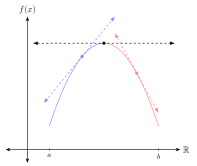
If $f'(c) = 0,$ then $c$ is a stationary point of $f.$
It is important to note that the converses of the first two implications are not true. Namely, a function need not have a positive derivative at a point to be increasing at that point, and likewise for a negative derivative. Furthermore, a zero derivative is also not necessarily indicative of either of the three possibilities, but it does bring with it a special name. The adjective "stationary" is perhaps an arbitrary synonym for constant, but it captures the fact that $f$ is "momentarily constant" at $c.$
Concavity
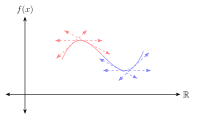
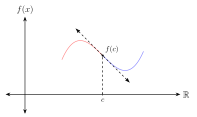
A real function $f$ is concave up at a point $c$ if there exists an $r > 0$ such that the tangent line at $c$ is less than $f$ in the interval $(c - r, c + r).$ Conversely, $f$ is concave down at $c$ if there exists an $r > 0$ such that the tangent line at $c$ is greater than $f$ in the interval $(c - r, c + r).$ A function need not be concave up or down at all points: if the tangent line at $c$ is greater than $f$ on $(c - r, c)$ and less than $f$ on $(c, c + r),$ or vice versa, then $c$ is an inflection point of $f.$ Likewise, if there is no $r$ at all for which any of these conditions holds, then $f$ has no concavity properties at $c$ at all. The terminology of "concavity" derives from the shape of the function's graph, where a concave up region looks like a valley and a concave down region looks like a hill.
Concavity and Second Derivatives
Second derivatives are closely related to concavity. In particular, there are three cases
-
If $f'' > 0$ in an interval $(a, b),$ then $f$ is concave up at $(a, b).$
-
If $f'' < 0$ in an interval $(a, b),$ then $f$ is concave down on$(a, b).$
-
If $c$ is an inflection point of $f,$ then $f''(c) = 0.$
Thus, the sign of the second derivative on an interval determines the concavity of the function along that interval. However, the direction of implication is reversed for the zero case - an inflection point implies a zero second derivative, but the converse is false.
Problems
Show that if $f$ is differentiable on $(a, b)$ and $f'(x) \geq 0$ for all $x \in (a, b),$ then $f$ is monotonically increasing on $(a, b).$
For $x_1, x_2 \in (a, b)$ where $x_1 < x_2,$ the mean value theorem states that there is some $c \in (a, b)$ such that $f(x_2) - f(x_1) = (x_2 - x_1)f'(c).$ Because $f'(c) \geq 0$ and $x_2 - x_1 \geq 0,$ it follows that $(x_2 - x_1)f'(c) \geq 0,$ so $f(x_2) - f(x_1) \geq 0.$ Therefore $f(x_2) \geq f(x_1),$ so $f$ is monotonically increasing in $(a, b).$
Show that if $f$ is differentiable on $(a, b)$ and $f'(x) \leq 0$ for all $x \in (a, b),$ then $f$ is monotonically decreasing on $(a, b).$
For $x_1, x_2 \in (a, b)$ where $x_1 < x_2,$ the mean value theorem states that there is some $c \in (a, b)$ such that $f(x_2) - f(x_1) = (x_2 - x_1)f'(c).$ Because $f'(c) \leq 0$ and $x_2 - x_1 \geq 0,$ it follows that $(x_2 - x_1)f'(c) \leq 0,$ so $f(x_2) - f(x_1) \leq 0.$ Therefore $f(x_2) \leq f(x_1),$ so $f$ is monotonically decreasing in $(a, b).$
Show that if $f$ is differentiable on $(a, b)$ and $f'(x) = 0$ for all $x \in (a, b),$ then $f$ is constant $(a, b).$
For $x_1, x_2 \in (a, b)$ where $x_1 < x_2,$ the mean value theorem states that there is some $c \in (a, b)$ such that $f(x_2) - f(x_1) = (x_2 - x_1)f'(c).$ If $f'(x) = 0$ for all $x \in (a, b),$ it follows that $f(x_2) - f(x_1) = 0,$ so $f(x_2) = f(x_1).$ Therefore $f$ is constant in $(a, b).$
Counterexample: Provide an example of a function with whose derivative equals $0$ at a point that is not an extremum.
Let $f(x) = x^3.$ Then $f'(x) = 3x^2$ and $f'(0) = 0.$ However, $f(0)$ is neither a local maximum or minimum of $f.$
Provide an example of a continuous function that has a local extremum at a point where its derivative is undefined.
Consider the function $f(x) = |x|.$ The point $f(0)$ is a local minimum of $f,$ but $f'$ is not defined at $1.$
Show that if $f'' > 0$ on an interval $(a, b),$ then $f$ is concave up on $(a, b).$
If $f'' > 0$ on $(a, b),$ then $f'$ is increasing on $(a, b).$ Consider $c \in (a, b).$ Because $f'$ is increasing, it follows that $f'(x) < f'(c)$ when $x < c$ and $f'(c) < f'(x)$ when $x > c.$
Denote the tangent line of $f$ at $c$ by
$$g(x) = f(c) + f'(c)(x - c).$$
We want to show that
$$f(x) > g(x) \quad \text{ on } \quad (a, b).$$
First, consider the case where that $c < x < b.$ By the mean value theorem, there is a point $p$ where $c < p < x$ such that
$$f(x) - f(c) = f'(p)(x - c).$$
Therefore
$$f(x) = f'(p)(x - c) + f(c).$$
Since $f'$ is increasing, we see that $f'(c) < f'(p).$ Since $x > c,$ it follows that $x - c > 0.$ Therefore
$$f'(c)(x - c) < f'(p)(x - c).$$
Adding $f(c)$ to both sides then shows that
$$f'(c)(x - c) + f(c) < f'(p)(x - c) + f(c).$$
By definition, this simplifies to
$$g(x) < f(x).$$
Therefore $f$ is concave up on $[c, b).$ The same reasoning shows that the inequality holds when $a < x < p < c,$ and so $f$ is concave up along $(a, c].$ Thus, $f$ is concave up along $(a, b).$
Show that if $f'' < 0$ on an interval $(a, b),$ then $f$ is concave down on $(a, b).$
If $f'' < 0$ on $(a, b),$ then $f'$ is decreasing on $(a, b).$ Consider $c \in (a, b).$ Because $f'$ is decreasing, it follows that $f'(x) > f'(c)$ when $x < c$ and $f'(c) < f'(x)$ when $x > c.$
Denote the tangent line of $f$ at $c$ by
$$g(x) = f(c) + f'(c)(x - c).$$
We want to show that
$$f(x) < g(x) \quad \text{ on } \quad (a, b).$$
First, consider the case where that $c < x < b.$ By the mean value theorem, there is a point $p$ where $c < p < x$ such that
$$f(x) - f(c) = f'(p)(x - c).$$
Therefore
$$f(x) = f'(p)(x - c) + f(c).$$
Since $f'$ is decreasing, we see that $f'(c) > f'(p).$ Since $x > c,$ it follows that $x - c > 0.$ Therefore
$$f'(c)(x - c) > f'(p)(x - c).$$
Adding $f(c)$ to both sides then shows that
$$f'(c)(x - c) + f(c) > f'(p)(x - c) + f(c).$$
By definition, this simplifies to
$$g(x) > f(x).$$
Therefore $f$ is concave down on $[c, b).$ The same reasoning shows that the inequality holds when $a < x < p < c,$ and so $f$ is concave down along $(a, c].$ Thus, $f$ is concave down along $(a, b).$
Consider $f : \mathbb{R} \rightarrow \mathbb{R}$ and assume it has the following property:
$$|f(x) - f(y)| \leq (x - y)^2.$$
for all $x, y \in \mathbb{R}.$ Show that $f$ is constant.
Hint: Write out the formula for the derivative of $f.$
Let $x \in \mathbb{R}.$ Define $h(y) = \dfrac{f(x) - f(y)}{x - y}.$ It follows that
$$0 \leq |h(y)| = \left|\dfrac{f(x) - f(y)}{x - y}\right| \leq \dfrac{(x-y)^2}{|x-y|} = |x-y|.$$
We can see that $\lim\limits_{y \rightarrow x} |x-y| = 0,$ so by the squeeze theorem, $\lim\limits_{y \rightarrow x} |h(x)| = 0,$ and therefore $\lim\limits_{y \rightarrow x} h(x) = 0.$ Note that $f'(x) = \lim\limits_{y \rightarrow x} h(x),$ so $f'(x) = 0$ for all $x \in \mathbb{R}.$ It follows that $f$ is everywhere constant.
Counterexample: Show that monotonicity does not imply continuity.
Consider $f : \mathbb{R} \rightarrow \mathbb{R}$ where
$$f(x) = \left\{ \begin{array}{ll} x & \text{ when } x \leq 0\\ x + 1 & \text{ when } x > 0\end{array}\right.$$
We can see that $f$ is monotonically increasing everywhere, but is discontinuous at $x = 0.$